Titan Rain was the U.S. government’s designation given to a series of coordinated attacks on American computer systems since 2003. The attacks were labeled as Chinese in origin, although their precise nature (i.e., state-sponsored espionage, corporate espionage, or random hacker attacks) and their real identities (i.e., masked by proxy, zombie computer, spyware/virus infected) remain unknown. The designation ‘Titan Rain’ has been changed, but the new name for the attacks is itself classified if connected with this set of attacks.
In early December 2005 the director of the SANS Institute, a security institute in the U.S., said that the attacks were “most likely the result of Chinese military hackers attempting to gather information on U.S. systems.”
This is very serious stuff. And if they can get into heavily defended top secret computer systems just imagine how easily they could get into yours or into the systems of your place of work. Against this background we have this amazing announcement from Google:
Like many other well-known organizations, we face cyber attacks of varying degrees on a regular basis. In mid-December, we detected a highly sophisticated and targeted attack on our corporate infrastructure originating from China that resulted in the theft of intellectual property from Google. However, it soon became clear that what at first appeared to be solely a security incident–albeit a significant one–was something quite different.
First, this attack was not just on Google. As part of our investigation we have discovered that at least twenty other large companies from a wide range of businesses–including the Internet, finance, technology, media and chemical sectors–have been similarly targeted. We are currently in the process of notifying those companies, and we are also working with the relevant U.S. authorities.
Second, we have evidence to suggest that a primary goal of the attackers was accessing the Gmail accounts of Chinese human rights activists. Based on our investigation to date we believe their attack did not achieve that objective. Only two Gmail accounts appear to have been accessed, and that activity was limited to account information (such as the date the account was created) and subject line, rather than the content of emails themselves.
Third, as part of this investigation but independent of the attack on Google, we have discovered that the accounts of dozens of U.S.-, China- and Europe-based Gmail users who are advocates of human rights in China appear to have been routinely accessed by third parties. These accounts have not been accessed through any security breach at Google, but most likely via phishing scams or malware placed on the users’ computers……….….more
So there you have it, official. The Chinese put malware on people’s computers which they then use to their own ends. What better way to achieve this than by using a browser video game? The client software for browser video game is on literally tens of millions of Western computers. The operators of these games even encourage you to put it on your work computers. And there is nothing to stop them then extracting all the information they want. Passwords, credit card numbers, email addresses etc. And your virus software will not show this up, because it is not a known virus. And your firewall will not protect you because you installed the client. I wrote an article on here “Is Evony Malware?”. Here is one of the comments that a reader called Lee added to this article:
I am a student studying computer games design at uni and decided to investigate Evony.com.
Just to see what some of these games are like etc. etc.
The game is actually kind of cool (found myself addicted and even spent a little money on it).
But I started to notice HUGE bandwidth use by the site as I played.
I am not the only one either, there are comments on the evony forums about this.
This is odd because all of the client info, the animations etc. are all downloaded in one big download at the start.
There is no streaming media so I began to wonder what was going on.
To cut a long story short I decided to break the law and reverse engineer Evony’s client.
Not to cheat. Not to rip them off or even to use even a scrap of the code.
But just to poke about a bit and find out what was going on, maybe even offer them some ways to improve things.
Aside from the fact that the whole thing is very poorly constructed (it is really very beginner coder level stuff. Reminds me of a lot of
what the first year students produce for assignments) it contained some very interesting information.
Included with the client are 2 peices of tracking software that monitor your web use and which applications you have open while the client is running.
These do not install independently on the machine though due to the limitations of flash and do not actually damage anything.
But they harvest massive volumes of information. My firewall was blocking a lot of outgoing transmissions and it turns out that these
were the data trying to be sent out. So they know nothing about me. lol.
However there is a LOT of data coming IN over the ports the client uses. In otherwords it is downloading something into my cache for use later.
I have bandiwdth restriction which slows these types of tricks down and I completely clear my cache every couple of hours if I am heavily using the net.
I also noticed that all the varanbles etc. are named Civony still and that there are multiple references to UMGE.
Even a couple of folders are simply called UMGE, one of these folders contains one of the spyware programs.
So I can only guess at where the data would end up if I didnt have a good firewall.
There are also commented out sections in the code which contain references to UMGE and Lam himself, though low on details.
Thank you for reading this.
Lee
Please note that I am not saying that Evony is malware or is associated with malware in any way. I am just repeating what other people have said. But personally I would not install it on my computer.
So take care out there. Only play browser games from reputable companies that you know the provenance of. Who owns them, where they are based, their phone number etc. To let just any browser game put their client on your computer is very dangerous, they can do anything they want once it is loaded and you won’t know anything about it and can’t prevent it.
That’s right, over 300 million dollars stolen just of the one game, Modern Warfare 2, in 2009. Obviously Activision had much more stolen from them with other titles, but MW2 is by far the worst affected. According to TorrentFreak 4,100,000 copies of the PC version of MW2 were stolen and 970,000 copies of the Microsoft Xbox 360 version.
Thieves using bit torrents are indulging in the biggest orgy of theft in the history of humanity. When they can steal with no chance of getting caught then they will. How they justify this appalling lack of moral fibre to themselves is beyond me. I have heard a whole litany of empty excuses from the thieves to try and justify their actions but the fact remains that they are benefiting from other people’s labour that they should have paid for but haven’t. So they are thieves.
And they are stupid because they damage that which they love. Activision are not about to go out of business because of this particular frenzy of stealing. But in the past plenty of other game companies have gone bust because of game theft. And many top creative game developers have left the industry for ever. We have lost a huge number of potentially great games to piracy. It doesn’t even need for the company to go bust, they can just allocate their resources elsewhere. There are nearly as many Nintendo DS consoles in the world as Wiis, PS3s and Xbox 360s combined. So where are all the great DS games? That’s right, piracy stops them even being written.
The fact is that if you want people to work for you creating great games then you have to pay their wages, they have to pay for their food and rent just like everyone else.
There are a number of possible solutions to this massive stealing problem:
Educate the thieves. Explain their low morality to them and the harm they do to the development of games. I think this has no chance of succeeding, they have proven, on a massive scale, that they are perfectly happy to steal.
Technical protection. This is the best solution. A game console’s main purpose in life is to serve as an anti piracy dongle. All three current generation home consoles succeed at this, the PS3 works best, followed by the Wii with the Xbox 360 putting up a distinctly average performance. But open, multi purpose platforms like the PC and the iPhone lack this technical protection and so piracy is rife.
Using the ISPs to stop peer to peer distribution of stolen IP. This is probably the main viable route. Already implemented in France and proposed for the UK and most other civilised countries. The scale of thieving is so enormous that the thieves are not directly punished, instead they get a warning letter. If they continue to steal they get another warning letter. Then if they ignore both these warnings they are disconnected from the internet. A very mild course of action against thieves, many of whom have stolen thousands of dollars worth of stuff they should have paid for.
Publisher activism. The publishers can go after the thieves that are stealing from them directly. However the thieves don’t like this and indulge in massive online activism to stop it. So the publishers, even though they are morally right to protect their property, are loath to take this sort of action for fear of Streisand effect.
Government action. There are millions of thieves out there that the government is turning a blind eye to. In fact government authority is being totally usurped. If I fancied a new Ferrari and went and stole it the police would show a great interest. However is someone steals a game that I publish, using torrents, they aren’t interested. Yet the Ferrari and the game are both the result of people’s labour.
Eventually something will be done, stealing on this scale is unsustainable whatever way you look at it. In the meantime game development suffers and the thieves are too stupid to realise it.
Logic says that there can only be three possible reasons for this. Firstly it is possible that Dean instigated this and didn’t want the job any more. Secondly it is possible that Evony didn’t want Dean any more. The third possibility is that the feeling was mutual and that they had a simultaneous difference.
Personally I like to think that it was Dean who decided to jump ship. Possibly because he came to the obvious conclusion that I was telling the truth and that there was no actionable case to be brought against me. However, even if he has taken the correct path, I may still sue him for libel, in London. Accusing a highly respected person such as myself of fraud in the Evony press release was a significant defamation. I am sure I can find a no win no fee solicitor in London to pursue the matter.
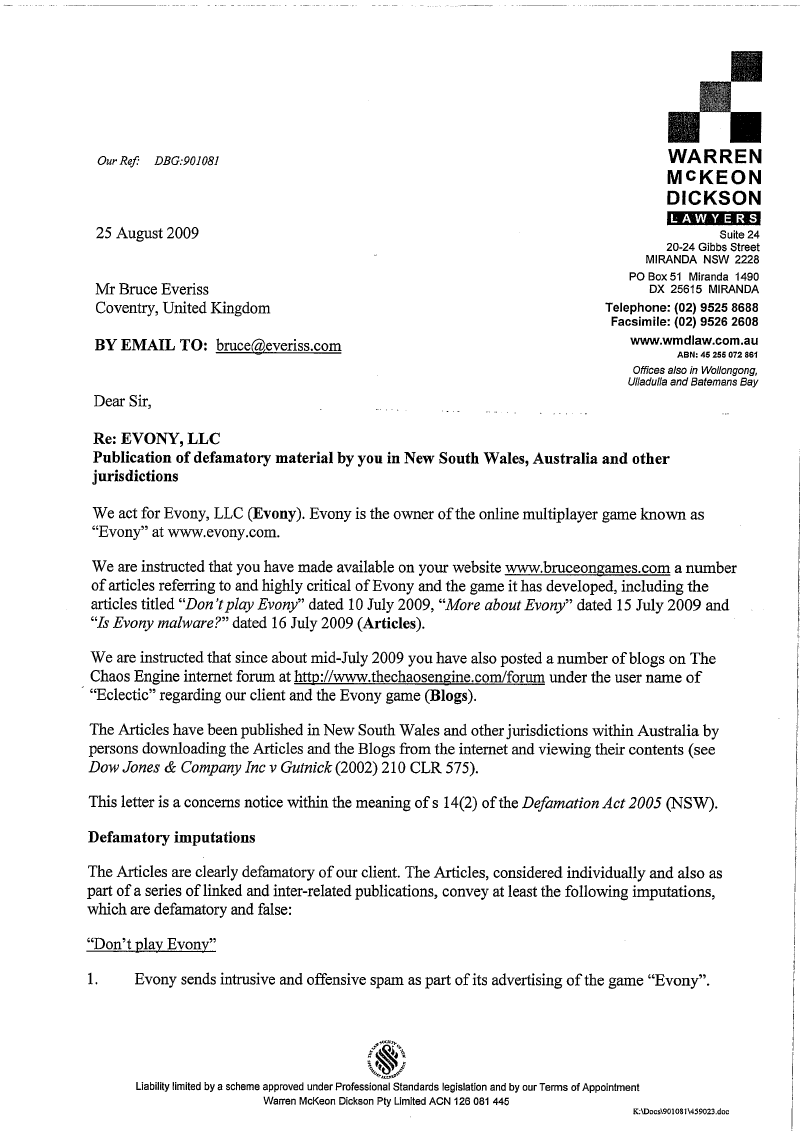
Evony’s new solicitor, Ric Lucas of Colquhoun Murphy in Canberra has decided to add injurious falsehood and claims under the Fair Trading Act against me. All amazing stuff considering that I have never been to Australia and my blog is not trading. Next they will be blaming me for global warming!
Creative Commons. From ultrakml’s photostream on flikr.
So the first hearing in this case is at The Supreme Court of New South Wales in Sydney on 14 December. I will not be there! The main issue for this hearing is to establish if Australia is the right jurisdiction to hear this case. Or whether it would be best held in another country. I am British and live in Coventry, England. Evony LLC, is a Delaware company from the USA. My blog is also published in the USA, on Dreamhost. So you would wonder what we are doing hearing this case in Australia. Suing for defamation in a country that suits the prosecution like this is called libel tourism.
The company that is suing me, Evony LLC, was not formed till 22 July this year, which is after the main articles that they complain about were published. I must say that to me this comes across as very strange indeed.
Now we come to something very, very interesting. The Defamation Act 2005 in New South Wales says, in section 9, that a company can only sue for libel if : ” (b) it employs fewer than 10 persons and is not related to another corporation.”
They are saying that a game with 11 million players is run by less than 10 people.
Another great video. Like the previous one it is posted on YouTube by someone calling themselves EvonyFraud. But this time they have produced a funny parody TV advert.
Once again there is no copyright so you are free to do what you will with it.
Well, I must say that I am amazed at this. Someone has put a lot of time and money into forensically examining the truth behind Evony. And Evony’s lies are exposed open for everyone to see.