Steve Jobs pours ridicule on netbooks, saying: “They’re slow, they have low quality displays … They’re not better at laptops than anything, they’re just cheaper”. Well I have news for him, after the launch of his iPad I think that my Acer Aspire One netbook is a better ownership proposition. Which is not what I was expecting.
So where have Apple gone wrong?:
Apple have a marketing strategy with iPod/iPhone of planned obsolescence, like Detroit carmakers in the 1950s and 1960s. The product line is updated regularly with features held back to make the next model more appealing. So many customers upgrade every year. This strategy is no longer valid because of Android. Apple need to maximise their benefits and features to stay ahead in the race. They haven’t done so and will be outperformed on price and specification by a myriad of competitors.
No OLED display, presumably this will be in next year’s model. Instead they have gone for IPS (In Plane Switching) LCD. This technology gives a wide viewing angle and good colours, however it switches very slowly producing motion blur which is not good for games. Also, compared with OLED, it uses a lot of electricity, resulting in a short battery life.
Not a proper competitor for Kindle. Amazon must be very happy today. The Kindle’s E Ink display technology is vastly more readable than any LCD. And Kindle will run for a week on a charge whilst the iPad only lasts 10 hours.
The iPad has no camera. What were Apple thinking about? This is an unbelievable omission which severely curtails the usefulness of the device.
Processing power. The iPad uses an ARM processor. The netbooks that Jobs derides can have ARM processors too. Or Intel’s rapidly developing Atom. So the iPad has no significant horsepower advantage.
No removable battery. This is naughty of Apple, these batteries have a finite life, so eventually need replacing. You have to send your machine back to Apple for this to be done. Which is costly and inconvenient. Also I have different sized batteries for my netbook for different situations and can change between them in seconds.
No multitasking. My netbook will do this. This is a very significant weakness.
No Adobe Flash. Huge chunks of the internet run on Flash and iPad can’t see it. Presumably Apple do this to protect their App Store revenue. My netbook runs Flash.
No Skype. Another massive omission and, once again my netbook can do what the iPad can’t.
No USB or Firewire ports. Seriously. My netbook has three USB ports. Once again Apple are seriously limiting what their customers can do with their machine.
Storage capacity is limited to a maximum 64GB flash drive. When netbooks often have far bigger hard drives and as many USB memory sticks as the user wants.
Not looking good is it? So what has the iPad got going for it?:
Apple fanboys and Apple marketing. This is cult like. Lots of people will buy anything they stick the Apple logo on.
Fantastic user interface. Apple really do lead the world at this and have taken it several steps further with the iPad. This gives the device fantastic touch and feel.
Price. For once Apple have a realistic price structure. They need it with the competition this machine is going to have. But remember that an iPhone costs just $180 to manufacture and the iPad will cost a similar amount.
The App Store. 140,000 applications. On the iPad existing apps run in a small window or scaled, so there isn’t much advantage over an iPhone. But the huge catalogue still represents a huge amount of capabilities for the device. iPad specific applications will obviously benefit from using the bigger screen properly.
Money. Apple have enough cash in the bank to buy several small nations. They can throw this at the iPad project till it works.
My Acer Aspire One is still the better device for me and my requirements. It has a mechanical keyboard and a big enough hard drive, it runs Windows XP and Firefox customised for my needs. I can use nearly 30 years worth of heritage software including all the established industry standards. Apple have failed to come up with something that competes with such a netbook.
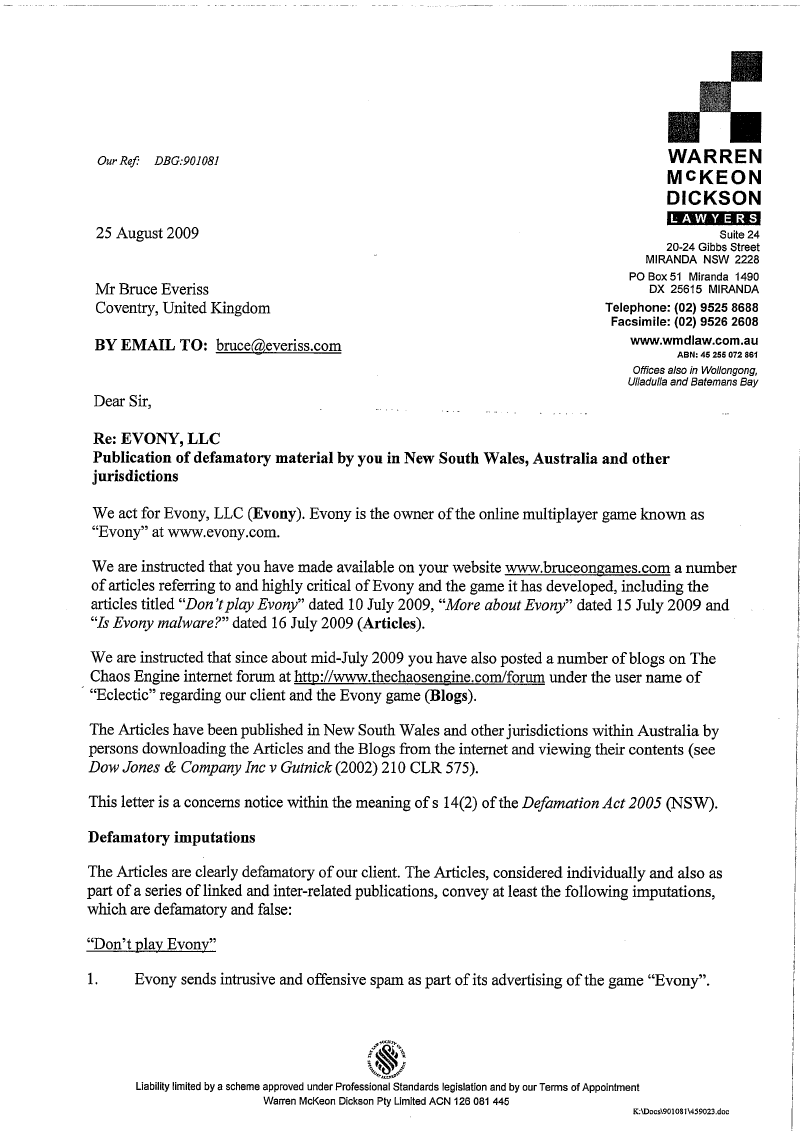
I have written a number of articles on here telling the truth about what Chinese gold farmers are doing with the game Evony. What I wrote was the truth and is supported by massive evidence from elsewhere. They are just trying to bully me, for instance threatening to sue in Australia in order to make things as difficult as possible. And it is ironic that they try to use the legal system against me when they blatantly stole other people’s game mechanics and graphics in order to make Evony. Also I wonder if they are trying to be so heavy handed against the Guardian? And cheek of all cheeks they are trying to deny comment spamming this blog.
Sony have reduced the manufacturing cost of the PS3 by 70% according to Nobuyuki Oneda, Sony CEO and EVP: “The cost reduction since we introduced the PS3 is very substantial and this is on schedule. We don’t disclose how much of the PS3, specifically the cost deduction was achieved during the past two years. But that is on schedule.” Pushed further he admitted: “About 70%, roughly speaking,”
Obviously this gives Sony room for a price reduction and thus make the PS3 less uncompetitive.
The 70% reduction is nothing special here. Firstly Sony were forced to rip a lot out of the original machine, including hardware backwards compatibility, to reduce costs. Secondly Moores Law reduces semiconductor costs by half every two years. And thirdly the Bluray drive was new and expensive at PS3 launch, now it is a mass production part which must be costing them a tenth as much to make.
So, as predicted, Sony have removed the UMD drive from the PSP and replaced it with 16 Gbytes of internal flash memory with the option of adding Memory Stick Micros. Content will be downloadable from the Playstation Network (PSN) and will include films, TV and games.
Online discuss has centred on the lack of a touch screen, lack of a second analogue nub and what looks like difficult ergonomics. So there isn’t really a wow factor out there.
It is ironic that Sony, who are championing physical content distribution using Blueray, have abandoned it with the PSP. Also this is another arrow in the back of high street game retail, who are becoming increasingly redundant. The writing is well and truly on the wall that their business model is on the way out.
What will make this device will be the available games. Developers and publishers don’t like PSP because of the immense piracy rate. For the PSP Go launch Sony have rustled up Gran Turismo, Little Big Planet, Metal Gear Solid and Jack and Daxter. A good start, but is it sustainable?
And, also ironically, Sony, from a different division, have Android phones on the way. So the PSP Go is yet another example of the lack of joined up management at Sony. Their right hand doesn’t know what their left hand is doing.
Future publishing is now worth only £30 million after reporting minisculey improved results. They are reaping what they sowed here with a disastrous historic lack of an internet strategy. Basically they didn’t see how chopping down trees as a communication medium would fall away so quickly. The new management are obviously correcting this but from a long way back. They should do it which makes these shares a bargain. Unless they get taken over first.
Developer whinges that XNA game prices are too low. Maybe in comparison with boxed retail console games, but these are vastly overpriced. I don’t see how he can complain when he knew what he was getting into. If he doesn’t like the way XNA is run he can always develop for the iPod or nGage.
Chris Lewis, VP of the Interactive Entertainment Business for Microsoft EMEA drops some hints about the next generation (phoenix) and how important scaling is to Microsoft: “I think this generation will be longer, because there is so much scalability. When you look at NXE, that is a complete revision of the interface and the look and feel and every aspect of the system. That’s not predicated by new hardware. We have fundamentally done that through software and services. So if you think of that scalability and the opportunity to enhance and develop what we do with this platform, then I think it’s very, very possible–and indeed appropriate–that this generation will be longer. But we’re not specific about when that will happen, and we don’t have a particular timeline that we share right now.”
The game addictiveness debate rumbles on, fuelled by Wrath of Lich King. We have to accept and allow for the fact that games can definitely be addictive. But that there are far worse addictions and vastly worse things in life. Dr Richard Graham, a child psychiatrist at London’s Tavistock Centre, told the BBC: “The problem with World of Warcraft is the degree it can impact and create a socially withdrawn figure who may be connecting with people in the game and is largely dropping out of education, social opportunities.” I don’t see anything massively wrong with people preferring to live a virtual reality, they are lucky to have the choice.