Entries Tagged 'Opinion' ↓
September 1st, 2008 — Opinion

High street game retail has never had it so good as it is now, with three console manufacturers all succeeding and an ever widening demographic. But this next year or do are the peak of a wave and it will be rapidly downhill from then. Already high street retail sells a far smaller fraction of gaming than online provides.
Firstly far more games are stolen on peer to peer networks than are bought. So people are perfectly happy to accept delivery of games in this way. Admittedly without paying for them.
Then there is the legitimate online gaming. Habbo, Maple Story, Runescape, World of Warcraft etc with tens of millions of players. Downloadable games from all three platform holders, which is exceeding their wildest expectations. Steam and the other online content providers looking after the PC market. And the 800 pound gorilla that is casual gaming.
The main function of consoles is to act as an anti piracy dongle. And whilst this isn’t broken high street still has a role for this generation. However the world is very rapidly converting to 100Mbps broadband, which makes a console as a media hub based on the internet a practical reality. One which Sony and Microsoft are both working towards with ever bigger hard drives.
An alternative future is to have server based gaming with a fairly thin client in the home, perhaps built into the TV. This approach has the benefits of far lower hardware costs and zero piracy. Microsoft have invested heavily with a Chinese TV manufacturer, probably for this reason and Sony are already a major TV manufacturer.
Then there is the view of Alex St. John of WildTangent who thinks that consoles will die out to be replaced by PC gaming. I am inclined to disagree with this for a number of reasons: cost, lack of standardisation, piracy, lack of platform holder to market it, horrible architecture, poor entertainment hub capabilities etc etc
Download offers a lot of advantages over retail. A far wider range of product would be on offer with no stock problems, delivery is far more convenient with the game loaded direct on your game machine, there is no plastic and cardboard to clutter up your house, cutting out the costs of distribution and retail mean games can be cheaper to buy and publishers and developers have a better business model with a long tail so are far more likely to create niche games.
So the future will definitely be online and could be powerful entertainment hubs or server based gaming. Or both. Or maybe PCs. What is for sure is that none of these options need a high street.
August 27th, 2008 — Opinion

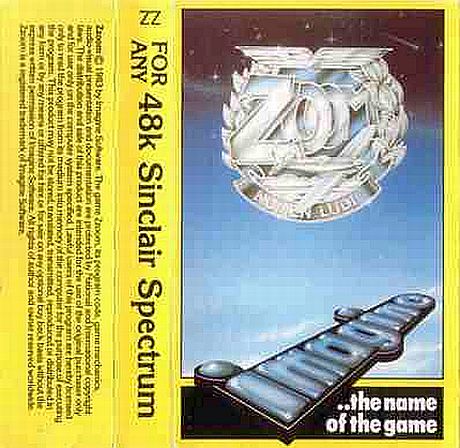
In the early 1980s at Imagine Software in Liverpool I was trying to give customers the most possible added value in the packaging content. The idea was to add more and more folds to the cassette inlay card, each with additional information. So I wrote a company profile for one fold and a profile of the game’s author on another and so on. Eventually, as more people became involved on each game, it became possible to concoct a list of credits to put on yet another fold. This may (or may not) be the first time this was done with a video game.
I liked credits because they gave the picture of a team behind the game, thus adding to its perceived value. Artists and musicians were obvious additions but I even put the tea trolley girl on the list, which pleased her greatly. This is nothing more or less than the film industry has done for years. They really do go to great lengths for the maximum credit list, no matter how insignificant a person’s contribution.
Games now have production teams that can be bigger than those for a film. So the credits have grown. However the implementation of these credits within our industry is still shoddy, inconsistent, unprofessional and badly thought through. Both from a marketing point of view and from the view of looking after your staff properly. The credits policy varies wildly throughout the industry, from zero recognition of any one’s input to a massive list of everyone possible, and all possible permutations in between.
One unfortunate practice is to only include members of the team still employed by the developer at the end of the project. And to leave out anyone who has left the team to work elsewhere. This is especially harsh on an MMORPG which can take a few years to produce. Here someone can put two or three years of their life into a project and still not get a credit. This has reared its ugly head once more with Mythic and their game Warhammer. The International Game Developers Association (IGDA) are not happy and their chairperson Jen MacLean said: “This policy is disrespectful of the effort of the game developers who worked on the game, and misleads both consumers and game industry peers.”
Equally misleading is the habit some companies have of giving production credits to senior management, even if they had nothing to do with the game. One of the worst for this was Bruno Bonnell, when he was in charge every Infogrames game was “A Bruno Bonnell Production”, even if it was created by a company that he had recently bought, so he could not have had any input whatsoever.
It is obvious that what is needed here is standard industry practice. A set of guidelines for credits for all publishers to adhere to that gives game purchasers the true story and which rightly looks after the people whose creative input makes the whole industry possible. Surely as an industry we should be mature enough to get this right.
August 26th, 2008 — Opinion

Despite supposedly employing the brightest people on earth and having the riches of Croesus, Google continually fail to extend its business model successfully beyond search advertising. This must be infuriating when it sees tech rival Microsoft being so successful in so many areas.
Google’s latest attempt to break out is the virtual world, Lively, which was launched in July. Browser based, it is really just a Second Life lite. And, apeing Second Life, there is nothing to do, so like Second Life it is deserted. It is a pity because Google have the in house expertise and technology to do this right and make a serious impact on the virtual world market. Instead it has concentrated on the social networking aspect, an area that is more than well served by entrenched competition. This at the detriment of the gaming side. Just like Second Life. Perhaps if it had been looking at Maple Story, Runescape, Habbo, Club Penguin, Guild Wars etc it would have had a better idea what people want.
Maybe Google could learn in this area from Rupert Murdoch, who has no campus full of geeks. With a low cost, low risk strategy he is leveraging his existing brand and customer base with a product that people actually want, TheLondonPaper casual gaming portal. This can be used as a template and reskinned as a bolt on cash cow for any of his myriad global empire of media. You can see that he is a businessman.
We have another Second Life alike about to burst onto the scene with Sony Home. This time it has a huge potential to integrate gaming with social networking well. If it succeeds this could be a seminal product that changes the gaming landscape. We will see. Certainly it will be an extreme disappointment if this turns out to be another Lively.
Back to Google and another recent launch of its, Knol. This user friendly knowledge repository is a competitor for Wikipedia, and Google are relying upon user generated content to get it up to critical mass This has the potential to be another Lively, but it could be what finally gives Google a toehole in a business outside search.
August 13th, 2008 — Opinion

After the second world war Britain had a big aircraft manufacturing capacity and the experienced engineers to design excellent civil airliners that would use that capacity. So when I was young there was a very strong lineup of civil aircraft being made here by different manufacturing companies. The Vickers Viscount and Vanguard, the Bristol Britannia, the Hanley Page Dart Herald and the de Havilland Comet. And now there are none. In fact the whole world airliner industry has consolidated down to just two companies on the whole planet, Airbus and Boeing.
To a similar or lesser extent this has happened in many other industries. For instance shaving razors have consolidated down to Gillette and Schick/Wilkinson Sword.
So what is behind this consolidation?:
- High costs of product development. Boeing are said to have “bet the company” a number of times when introducing new aircraft types, so great are the costs. These costs can only be recovered across a large number of sales and these can only achieved by global sales. So we move from national markets to regional markets to global markets. And with each of these moves the number of organisations that can be supported is reduced. And so it is with games, the world’s top handful of publishers are global organisations.
- High cost of sales, marketing and distribution activity. The publishing side of releasing a AAA global game title can often cost more than making the game. This is a massive investment and so the same reasoning applies as it does to product development costs.
- Spreading the risk. A triple A game can make a lot of money if it succeeds and becomes a chart hit across a few countries. But it will cost the publisher the same amount if it fails. And nobody is good enough to only publish guaranteed hits. So a publisher needs to be big enough to have enough funds from hits to cover the costs of the failures. And as more fail than succeed this requires a consistent high volume of titles just to ensure survival.
- Surviving business and economic cycles. The game industry is growing strongly now but it was hit very badly by piracy in the home computer era and again at the end of the PSX cycle. Even now boxed PC games and PSP software are being decimated by piracy. It takes big resources to survive these downturns.
- Financing the business. If you want to borrow £100,000 it is very difficult. £100 million is a lot easier. A big global corporation can borrow more cheaply and in more different currencies to suit their business needs. Look at how easily Electronic Arts have raised the funds to buy Take Two despite their current losses.
- Buying the best resources. If a Harry Potter or Lord of the Rings license comes along it is easier for a global giant to buy it. So all the best resources gravitate to the biggest companies. Especially the best management. Which only leads to a virtuous cycle of them becoming even bigger.
- Clout in merger and acquisition activity. The bigger a company is the more difficult it is to take it over. And the easier it is for them to buy other companies. We see this all the time and will see a lot more of it.
As you can see the cards are so heavily stacked in favour of the big guys that it is surprising that smaller publishers still exist, what is for sure is that at the end of each year there are less. And it is inevitable that British publishing goes the same way as British civil aircraft production. And for many of the same reasons.
August 4th, 2008 — Opinion

One of the features of the Sony Playstation PS3, over it’s short life, has been the inconsistent and misleading messages coming from senior Sony management. Starting in early 2006 when Ken Kutaragi announced that the PS3 would be simultaneously launched in November of that year in Europe, North America and Japan. With 6 million units to be shipped by the end of March 2007.
In December 2006 Phil Harrison (then president of worldwide studios) said: “Backwards compatibility, as you know from PlayStation One and PlayStation 2, is a core value of what we believe we should offer. And access to the library of content people have created, bought for themselves, and accumulated over the years is necessary to create a format. PlayStation is a format meaning that it transcends many devices — PSOne, PS2, and now PS3. If the developer wrote the game according to our technical requirements checklist, we will have what we believe will be almost perfect backwards compatibility.” Having in August that year also criticised Microsoft for planning to put two versions of the new Xbox 360 console on the market, claiming the decision will merely “create confusion” for consumers.
In fact as late as February 2007 Harrison was saying: “I believe that the Sixaxis controller offers game designers and developers far more opportunity for future innovation than rumble ever did. Now, rumble I think was the last generation feature; it’s not the next-generation feature.” And in March he said: “We have made a technical change to the machine which moves us from being a hardware-embedded backwards compatibility solution to one which is a combination of hardware and software.”
In January 2007 Sony America boss Jack Tretton revealed that the platform holder wouldn’t reduce the price of PlayStation 3 until at least mid 2008 saying: “I think the consumers that get their hands on a PlayStation 3 clearly see the value and not only want to buy one for $599, in some instances they’re willing to pay ridiculous prices on eBay.”
SCEA’s senior vice president of marketing, Peter Dille, said backwards compatability went because of price:”We’ve been hearing loud and clear that price is more of a primary concern to consumers.” Meanwhile Jack Tretton said the removal of PS2 backward compatibility wasn’t “dramatically reducing Sony’s cost of manufacturing” instead it was done to ”encourage buyers of the entry-level PlayStation 3 to purchase more games designed specifically for the new system.” But David Reeves, president of Sony Computer Entertainment Europe disagreed with both of them saying removal of backwards compatability: “has been the result of extensive research into the entertainment needs and preferences of the next-generation PS3 owners”. If three different reasons aren’t enough for you, Ray Maguire, boss of Sony UK said: “we’re still better off using that money that we’d put into backwards compatibility in either investing in new games or using that money to help support bringing the price down so that people can get into the franchise”.
Meanwhile Sony Computer Entertainment president Kaz Hirai said that Home would not be realeased in 2007 and would be delayed until it could “truly meet the needs and feedback of the users.” And that it wasn’t because of technical problems.
And back to Sony Worldwide Studios boss Phil Harrison who, talking about Europe, said. “This is the third continent out of three, but it is the most important.” Which is why we pay more for the hardware and are behind on game releases.
So, there you have it. If the bosses of Sony don’t know what is going on with the PS3 then how are the customers supposed to?
July 15th, 2008 — Opinion

In an interesting news item it was revealed that outside investors had risked $184 million in virtual worlds in the first quarter of this year and $161 million in the second quarter of this year. Giving an annualised rate of over $600 million dollars a year. This is actually understated considerably as many deals are not visible. Also remember that this is just what outside investors are putting in. The industry itself is also investing heavily in this area so the total spend on virtual worlds development is massive. But much of this spend will be money thrown away.
Virtual worlds have two features that make so many people want to risk so much money. I have seen this myself having been involved with The Realm, an old school 2D MMO and with Dragon Empires, one of many abortive attempts to get a slice of the MMO pie.
The first feature is that virtual worlds can be a license to print money. Not just a bit of money, not even lots of money. We are talking about immense amounts of money. World of Warcraft, the monster that dominates the marketplace, generates several million dollars of revenue every day. Human greed means that there are a lot of people who would like a slice of this. For many even a small slice would do.
The second feature of virtual worlds is that they can do a lot of things that could not have been done before and which cannot be done any other way. The potentials are infinite and massive. An example is the virtual world of Baghdad that all US personnel “play” before being sent there. This doesn’t just teach the physical layout of the place, it also teaches the reactions and behaviour of the local populace and the threats and problems that will be encountered in the real world. Having played this personnel arrive on the ground already up to speed and more able to do a good job from day one. You can extrapolate this idea to an infinite nuber of areas of human activity.
So we have this seductive combination of infinite possibilities and huge revenue potential. No wonder so many people are risking so much money.
But there are a problems. When you write a conventional game the development staff hand over the gold master and go to the pub. Job done. With virtual worlds creating the initial product is just the beginning. It needs constant tweaking, updating and expansion.
One reason for this is “churn”. If there is a competing product or products, and there always is with public products, you will constantly lose customers to it. So you have to constantly give your customers more and better things just to minimise customer loss. The same applies to marketing. This needs to be constant just to replace the customers who have been lost. So for development and marketing an MMO is a never ending treadmill.
Then there are the technical problems. Part of the virtual world lives on a massive server and part (sometimes very little) lives on the user’s computer. These two parts have to work together. Then the server has to run a consistent playing environment to hundreds or even thousands of people at the same time. And all this has to be scalable to many different servers around the world. This is technically and managerially very demanding. Which is partially why most virtual world development hugely over-runs on both development time and budget. And why so many are launched on the public in an unfinished state.
With virtual worlds MMORPGs are the most seductive for investors because they appeal to the greed impetus most. However non MMORPG virtual worlds can make a good investment if you are a monopoly supplier to a corporation or the military. There is no doubt that virtual worlds will play an ever increasing role in many facets of our daily lives.
In the real world many MMORPGs are still born, canned often after many millions of investment. Those MMORPGs that do see the light of day often never make a profit. These are the realities of this sector.
So virtual world investment is only for the very brave. Even proven experts with a track record have failed (Ultima Online, Asheron’s Call, Anarchy Online, Earth and Beyond, The Sims Online and so many more). And the numbers involved in failed virtual worlds each year are almost impressive as the revenue figures for the few that actually work commercially. Far more projects fail than succeed.
July 4th, 2008 — Opinion

Firstly lets define what is meant by fanboy. What we are talking about is someone who has an irrational, emotional attachment to an inanimate piece of electronic equipment that makes them act in a manner that borders on the sociopathic and sometimes even crosses that border. Most gaming enthusiasts, even those who spend an inordinate amount of time and money gaming, are not fanboys. In fact fanboys probably spend a lot less time playing games than the true gaming enthusiast does. This is because, for a fanboy, the brand and the equipment are often far more important than the actual entertainment of playing games.
The vast majority of video game fanboys support the Sony brand. This makes them vehemently, sometimes aggressively anti Nintendo and anti Microsoft. This may sound pathetic to a normal balanced adult but it is true. Let’s look at some of the reasons that people become fanboys.
- Sony make sexy looking kit. Always have done, always will do. Lots of people will only buy Sony kit just because it looks so good. Nintendo kit is always just functional and the original Xbox was an ugly brick. Microsoft have learned their lesson with the 360 which is very nicely styled. It still isn’t a Sony though.
- The Sony brand dominated the market for a long time. To the point that in mass popular usage the word “Playstation” became synonymous with the word “console”. In the real world Nintendos and Xboxes are often referred to as “Playstations”. This is just like most people calling petroleum jelly “Vaseline” or vacuum cleaners “Hoovers”.
- Sony marketing baffles brains. With Playstation 2 they called the CPU the “Emotion Engine” and issued press releases on the wonderful and amazing things it would do for games. When the reality is that the Xbox was more powerful. Likewise they hyped up the Cell processor in the PS3 saying that the first PS3 down the production line would be the world’s third most powerful computer (this is just from memory so may not be exact, however the claim was outrageous) when in fact there is little difference between the capabilities of the PS3 and Xbox 360. In fact so far the vast majority of games run better on the 360.
- A lot of the great hardcore gaming franchises historically appeared first on Playstation. Mainly because for a long time there weren’t many other options for a developer. Just now the 360 has the best gaming catalogue in this generation but the fanboys haven’t woken up to this. They relive past glories and hope for future promises.
- Gamers spend a huge amount of time playing games. Sometimes 30 hours or even more per week. So the console becomes the gamer’s “partner” in his entertainment. It is his buddy in all the adventures that he has. So he becomes emotionally involved with his little friend. Even though it is mainly a moulded plastic box.
- Gamers spend a very high proportion of their disposable spend on their hobby. This is a big commitment that means making other sacrifices. So for this spend gaming owes something back. Something more than just entertainment. Something bigger and more fulfilling. Something emotional.
- Peer pressure, let’s face it, everyone is a lemming in one way or another. Look at all the yuppies in their BMWs because they have to have the badge. So it is with a certain demographic that Sony targeted with their marketing. If you were in this demographic it became more than cool to own a Playstation. It became essential for your self esteem. Because your peers would look down on you if you couldn’t walk the walk. And that meant you were left with little option but to buy one to gain the bragging rights and in turn put pressure on anyone in your peer group without a Playstation.
- It is an unfortunate male characteristic that they like to form gangs and then bully people who aren’t part of their gang. You see it in every schoolyard. And when men grow up they still do it but in other ways. At the football club, in the pub and at work. In fact anywhere the tribal genetics can break through the thin vaneer of civilisation. So it is with a Sony fanboy, he can get on the internet and join in harassing and bullying anyone and everyone who isn’t a member of his gang. In fact many fanboys enjoy this online warfare so much that they have little time left to actually play games. It is all very Lord of the Flies.
- Defending the honour of your family. To many fanboys the emotional invovement with their machine is such that it has become a member of the family in everything but name. So when something comes along that could be better in any way then it becomes a matter of honour. And the Wii and 360 are both better than the PS3 in some ways. So that means war. It is very obvious that if the competing consoles hadn’t been so good then the Sony fanboys wouldn’t have been so vehement and agressive. This is the biggest single factor in the current Sony fanboy phenomenon.
It is not just Sony Playstation that creates fanboys. Apple have the same effect (though to a lesser extent) with their computers and with their iPod/iPhone. And, quite interestingly, if you look at the reasons above many of them also apply to these Apple products.
Finally fanboys love articles like this. It makes them feel important and gives them a focus for their anger and resentment.