Television is old media and, as such, it is rapidly losing relevance to people’s lives. It lacks interactivity, connectivity and non linearity so it is doomed by its technical inferiority. And this is reflected in the behaviour of the viewers who are deserting the sinking ship in droves for the greener pastures of the internet and video gaming.
The latest news is that in the UK online advertising spend is now greater than TV advertising spend. In the first 6 months of this year total advertising spend, in the recession, fell by 16%. So it is amazing that in the same period online advertising rose by 4.6%. This is a massive performance and reflects the fact that many marketeers are now realising that they have to follow their customers.
Rupert Murdoch is being hung out to dry in all this. He has not moved sufficiently from old to new media, so is hugely exposed to the switch in advertising spend. Earlier this year he proposed charging for online news access in an attempt to recover lost revenues. The problem with this idea is that unless every news provider does the same he will just lose his audience. And in the age of the blog the number of news providers is just about infinite, so this will never happen.
Ironically this is happening just as there is an explosion of video on the internet, but served up in a completely different way to commercial television.
I have written about this before, how soon consoles and PCs will not be needed to play games because televisions will be smart enough to do the job on their own.
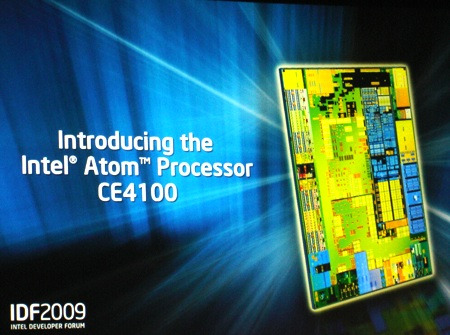
The Atom CE4100 is what is known as a “System on a Chip” (SoC). So adding just this one extra chip to any media device (a set top box or the television itself) puts a whole computer system inside it. One effect of this is to bring the internet to your television. And with the internet comes games. Another effect will be to hasten the demise of DVD and Blueray players, why store bits of plastic and cardboard in your house when everything ever recorded is available for instant streaming?
The humble television is about to undergo a revolution. The current LCD devices are just an interim technology, they are large and flat but they are over complex, use excessive energy and have poor picture quality. OLED technology, which is just hitting the market, is vastly simpler, uses a fraction of the energy and gives a far better picture. Because they can be manufactured by lithography they will become very cheap, they are also ideal for making 3D displays.
The low power usage of OLED (and of the Atom CE4100 and future such devices) mean that TVs will become truly portable, they will merge with the tablet netbook into one device. Also the low cost means there will be several televisions per person. Moving pictures will be everywhere in our lives.
For gaming this will accelerate our move onto the cloud. Not only will paper and cardboard distribution disappear, the dedicated gaming platforms will also go. Because every television will be a gaming platform, connected to the internet and with significant processing power of its own.
Interfaces will be interesting. Small screens can be the interface themselves by physical movement of the whole screen, as with an iPhone, a bit larger and we get into touch screen territory and big screens will use something like Natal.
Another way to look at what is happening is device integration. The television, computer, telephone, game console, camera etc etc are integrating into one device that will do everything.
I receive a lot of supporting emails about this whole Evony situation. Many with really good evidence which I can use in court to totally prove that what I have said is right. Obviously I am not publishing these. However I have received this by email which shows another side of Evony that is unpleasant:
Bruce,
Attached is an audit trail of my communication with Evony support. I don’t know if you want to blog about this or not. (I would like to keep my name private).
I just thought I should tell someone in the public spotlight of the willful disregard for the antisemitism found on Evony’s gaming community. I have written to Evony over 1 month ago, and they still refuse to take this character down. There has been several communications I have written, but all I get is their canned message that someone will look into it.
In my opinion, this is blatant promotion of hate for jews with no action on Evon’y part at all. I have attached two screen shots.
Thank you for your time.
XXXX
———- Forwarded message ———-
From:
Date: Mon, Aug 24, 2009 at 8:18 PM
Subject: Re: Thanks for Your Help
To: Evony Customer Support <reportname@evony.com>
Server 46… Below are screen shots
On Sun, Aug 23, 2009 at 11:45 PM, Evony Customer Support <reportname@evony.com> wrote:
Dear player,
We are sorry for the disturbance brought by the player’s inappropriate naming. Circumstance described in your mail has been reviewed by Evony team and prompt investigation would be put forward. Thank you again for reporting the problem with us for a more healthy and peaceful gaming environment.
Note: Please provide us with the server you are playing. A screenshot of the inappropriate name or offensive mail will help us to deal with the issue more efficiently.
Regards
Evony Team
I find that you allow someone to name an alliance \”Nazi\” very offensive. If you want people to join the Evony community then you need to hire someone to do some prudent censorship. You want us to write a review? How about if someone wrote a review that you allow hate speak and anti semitisim on your servers? How would that be for a review?! I should not have to accidentally stumble on to this. There should be some filters already in place.
The fact is that EA would be very cheap to buy, because they have been making big losses for some time whilst the industry around them booms. These losses are because something is wrong within EA, fix that and you have bought a bargain.
Expert Wall Street analysts are saying that EA would be a bad fit for Microsoft. They are wrong and here’s why:
Microsoft are a software company. EA are a software company. So Microsoft would be buying more of the same.
Microsoft have lots of platforms they need content for. Live (which will ultimately support many hardware devices), Zune, Windows, Windows mobile, the upcoming tablet, the 360 and the upcoming 720 (phoenix) that will run alongside it. Also they must be working on thin client smart TVs. That makes at least 7 platforms.
EA own a truly formidable portfolio of studios that can be bought cheaply here. Put in harness and properly managed they are an outstanding resource in the industry.
EA also own a fair amount of original IP. Once again this can be leveraged massively onto all those Microsoft platforms.
If Microsoft don’t buy EA then someone else will. And that someone else could be Apple or Nintendo, either of which would put Microsoft at a massive competitive disadvantage across many product areas.
Microsoft have Natal coming. This has future potential beyond that even of Windows. By buying EA they would create a commitment to Natal that would help ensure that this potential is realised.
So how did EA get into the position where their stock market value is a small fraction of their real worth?
EA traditionally made games using other people’s IP. James Bond, Harry Potter etc. As the industry evolved the consumers moved away from this towards original IP which better used the technical advantages of gaming as a media (non linearity, interactivity and connectivity). EA moved too little and too late to follow the market.
The boxed retail console game business model on which EA depends is largely broken in this generation of platforms. Only blockbusters work. EA were too late in seeing this and persisted with products long after they should have been dumped.
Management of an organisation can be done efficiently at minimum cost. The British ran Imperial India with few civil servants, for instance. However it is also possible for management, because they have the power, to become self serving and overly expensive for what they do, with empire building, secretaries, bloated expenses and a pile of other ills. I think that perhaps EA are not quite the mean, lean management machine that they could be.
EA launched products onto the market that would not work because product quality made them uncompetitive. Warhammer Online is a prime example.
EA has a long history of buying studios which then went downhill when the EA bureaucracy was imposed upon them.
Any behavioural expert will tell you that working long hours, especially at something creative, is unproductive. Enlightened game developers realise this and get the best out of their workforce. EA have been long time proponents of development crunch, which surely cannot be a good thing.
EA marketing owes more to the 1960s detergent industry than it does to modern best practice. They continue to spend massively on TV airtime instead of matching their marketing effort to the behaviour of their customers. Also they seem not to have adapted well to the brand building necessary when you create original IP.
For a long time I thought a global media company would buy EA. News International would be a very good fit, but Rupert seems to be a long way behind the market these days. So now we are in a position where EA seems to have more economic advantage to a platform holder than to a media company. One thing is for sure, they are a very ripe takeover target indeed.
The mechanic behind games is quite simple. Firstly you are given assets or skills, secondly you are given a task or a problem to solve then thirdly you are rewarded when you succeed. This is simple but compelling to the human mind. Put a whole pile (or sometimes just one!) of these mechanics together and you have a game.
Massive multiplayer games (MMOs) are different because they are persistent worlds and the game developers cannot create an infinite number of mechanics, so they work by making the player repeat mechanics lots of times in order to progress in the game. This is called grind.
Some bright sparks came up with the idea of doing the grind for other people as a business (called gold farming). They play the game then sell the result of their work in the real world for real money. So the purchaser of such in game assets is paying to cheat.
Approximately 400,000 people are employed in China and other Asian countries to play these games to manufacture in game items.
These people work at this mining for 10 to 12 hours a day for a salary of around $145 per month.
Between 5 and 10 million game players in the West are buying these items.
Total revenue of this mining industry is between $500 and $1 billion per year.
So now the inevitable has happened. Gold farming has gone first party. People are now making games where you can bypass the gaming mechanic by paying real money to the game publisher.
This mechanism can be made especially invidious. New players to a game can be given protection from the other players for the first week of play and be given a whole pile of “free” in game assets to get them started. The problem comes at the end of the first week when they are hooked on the game having committed so much time and emotion to it. However in order to be competitive with the other players now attacking them they have to start to spend real money. The more they spend the more stuff they have to compete with.
And the amount of real money that these subverted games need off a player can be remarkable. They tend to take it off you in $30 lumps, but they are geared up to take as much as $3,000 off you at a time. Which makes these some of the most expensive games in the world to play. Even though their marketing says that they are “free”. And often they are inferior copies of established games and are nowhere near as good as games that cost a fraction as much to play.
There are now a huge number of people out there who have video gaming as a hobby. Quite a lot of these have thoughts about working in the industry, even though they don’t have the faintest idea what working in the industry is like (mostly boring, repetive, underpaid, hard slog). Most say they want to be “game designers” though they haven’t the faintest idea about basic game mechanics and also though there are actually relatively few game designers in the industry compared with other skills.
So there is a ripe market out there of wannabe game industry workers who are pretty ignorant about what it actually means. So the universities have set up loads of courses to take their money off them, 330 at both university and college level, according to UCAS. The thing is that relatively few graduates of these courses actually end up working in the game industry. And I have seen it said that there are more people on these courses at any one time than there are working in game development in Britain. So there is a pretty big missmatch between the requirements of industry and what the education system is providing.
In the real world what the game industry is desperately short of is people with good physics and maths degrees. But then the whole country is short of such graduates. They can get jobs very easily and command good remuneration.
Now to add to the options for wannabes there are home study courses from an organisation called Train2Game. These are “Designer Courses” and “Developer Courses”. As far as I can find out they send a salesman round to your house, the course costs £5,000 and they will “lend” you the money for it. They have a promotional video which in my opinion paints a picture of the industry and anyone’s chances in it that is perhaps a little bit rosy.
The good news is that these courses have industry input, from DR Studios (formerly Deep Red Games) who are specialists in strategy games. Further good news is that the courses are endorsed by TIGA.
If you are a game industry wannabe my suggestion is that you have a look at the Blitz Game Studios Academy website. This gives you good inside information from a top game developer for free and is one of the best places to start looking on the web.
So the BBC Watchdog TV programme did a piece about PS3s being less than bulletproof. The claim is that half a percent of PS3s fail. And as they sell in the millions this is still a lot of machines. Once your PS3 is more than a year old Sony charge about £120 for fixing it, whereas Microsoft, with their Xbox 360, give a three year warranty. But Microsoft were pretty much forced into this when earlier 360s showed a far higher incidence of Red Ring of Death (RROD) than the half percent we are talking about here.
These game consoles contain a lot of electronics, especially early in their product lives. Later models contain progressively fewer components as the semiconductors are developed. These electronics give out a huge amount of heat and as the consoles are built to a price this can sometimes become a problem. Users make the problem worse by putting their machines in confined or hot places or by unknowingly blocking the ventilation. Heat damage takes two forms. The sheer intensity of it can fry components, then there is the shrinking and expanding of everything as the machine is switched on and off, which is cyclical damage. And which is why some people leave their computers permanently switched on. Another problem is dust build up inside the machine over time, which can prevent the cooling system working.
Whilst for most owners this is pretty much a non story it must be pretty infuriating for those that suffer it. The only real answer is to put more engineering into manufacturing these machines, but then they would become more expensive to buy.